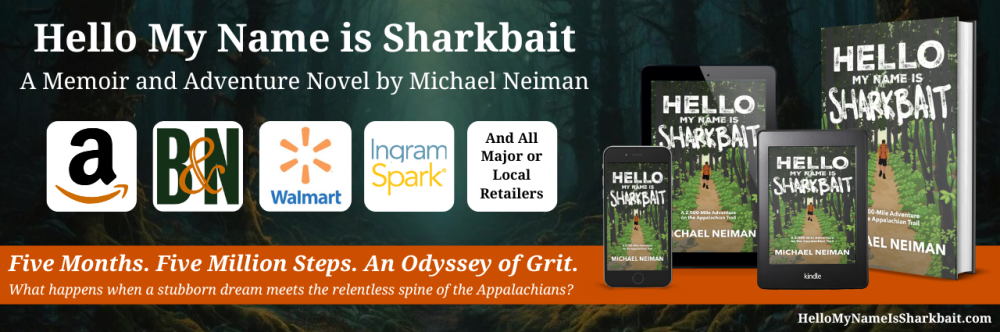

Pre-Order open! Hello My Name is Sharkbait is official on Amazon and available for Kindle pre-orders now! Paperback, Hardcover, and eBook are all approved and set for launch on December 24th across all platforms and bookstore locations. Pre-order is for Kindle only (not my rules, blame Amazon), so if you want a physical copy, you’ll need to wait until Christmas. And, no Audiobook yet (more on that later). It is surreal to see this finally out in the ether after so much work, and also more than a bit scary that there is no going back. I hope you like it. And if you don’t, I hope you give me a 5-star review anyway. No, seriously, do that. I’m like your Uber driver, begging for validation and social acceptance to drive sales! And if you want to learn more about the publishing journey that got me here, read on below…
If you read last week’s post and thought the editing process was cumbersome, boy do I have news for you. There is a WHOLE world of complexity and confusion to publishing, and I am starting to think it is on purpose to stifle competition. The good news is that there is a shortcut at every turn. The bad news is, they all come with hefty trade-offs. Trade-offs I wasn’t willing to make. So, as usual, I made this harder than needed. But in the end, I am glad I did.
Let’s get one thing out of the way, there are 2 routes to publishing: Traditional and Self. Six months ago, I began the traditional publishing route. I was eager, optimistic, and naïve. I had something that EVERYONE would want. Right?! … right? Maybe, still to be determined. But here’s what happened…
Querying. In traditional publishing, this is the next step. You have a manuscript … maybe it’s raw, maybe it’s edited and polished. You write something called a query letter and spam blast it to every publishing agent under the sun that you think hope pray will notice. That agent then gets you a publisher, editor, illustrator … all the things you expected to be easy and done for you, because you watched Younger on Netflix. I liken this to the kid who was lead in their High School production of West Side Story, flying out to NYC with a stack of headshots, then standing at the top of the Empire State Building and flinging them into the air. Everyone was bound to pick up the flyers and start fighting in the street about who gets to represent this amateur star-in-the-making. Right?! … right?
I had an awesome query letter. It led with a great hook, inspired comparison to other noteworthy authors in my genre, offered something unique, and called out my success in previous writing with this blog and Platinum Blazing. I spent weeks researching agents (who all annoyingly have different submission rules btw), sending a handful of inquiries. No one cared to even respond. I researched more, talked to other authors, Googled and YouTubed … a lot … and realized most first-time writers never get published traditionally. Agents simply don’t care about you because they think you have little to offer. To prove them wrong, I’d need to spend every hour of free time (I had none) door-knocking, networking, talking myself up at local author events, selling 10,000 books independently to get noticed … or go it alone. I’m sure I could have kept at it and proved to be the exception, but ain’t nobody got time for that. I had a full-time job, two toddlers, a new house that refused to go even a month without needing something repaired, and on and on. So I decided to learn everything I could and self-publish. I think I could now publish a book on how to self-publish. No, seriously. I am an expert. And I did everything wrong along the way to prove it.
Formatting. Ok, so based on last week’s post, all the editing is done. You have a final draft manuscript and now it’s time to put it into a publishable format. This was so cool to see, like watching a pile of ingredients rise as a cake in the oven. You can do this yourself, or seek out very affordable outsourcing. I found my formatter from a YouTube recommendation and was incredibly impressed with his attention to detail to match my own low high-functioning OCD. The formatter’s job is to take your manuscript and get it print/digital ready. Print-ready is easy, just takes a little Microsoft Word know-how. But the epub files for reading on Kindle and non-Kindle devices are a bit more involved. I picked from a dozen templates the formatter offered, then he loaded everything in and sent the files back to me a couple days later. I’m sure he had a software solution that simplified all this, but the product he sent back was beautiful. Now all that was left to do was meticulously review all 390 pages in the 4 formats and make sure nothing looked off. Did I like how the title page is centered? The way he formatted text messaging? Did a single word to end the chapter slip to the next page? We went back and forth a few times on image sizes, headings, formatting, and fonts … so many fonts … until it looked perfect.
Warning, major frustrations ahead.
Proofreading. Some people say you should proofread before the formatting, others say after. I wish I had listened to more people, as it would have avoided so much rework and embarrassment. I made a gross miscalculation that my Copy and Line Editor caught all the spelling and grammar errors. In truth, he may have, but his edits sometimes led to minor rewrites on my part that likely introduced new errors. And I made another error trusting Amazon’s proofreading software, which said there were no errors. I was so proud of the finished file that I shared it with Dana (who politely refused to read it previously until it was done). She didn’t get past the dedication before finding an error. Then she found another in the first sentence of the Preface. I yanked the Kindle from her grasp and spent an entire weekend re-reading my book, cover-to-cover, and meticulously proofreading again. I had a list 5 pages long by the end and buried my head in my hands. When I say I almost cried that this was the product about to go out with my name on it, I mean it. To be triple-safe, I bought proofreading software and ran every chapter through it to catch and fix anything I missed during the weekend’s read. I’m confident now of two things: 1) this book is ready for primetime, and 2) there is undoubtedly an error I missed. Perfection is really hard to achieve, so I welcome any errors my early readers find that I can update into a Second Edition. I gave the updated manuscript to my formatter and loaded the updated file from him to Dana’s Kindle for her to read again. No word yet if she made it to chapter one error-free.
ISBNs, Barcodes, Pricing. Ok, now we are ready to load the manuscript into Amazon and Ingram Sparks (distributor for everyone else), but are immediately hit with another snag. No way to proceed unless you provide an ISBN and barcode, or let Amazon or IS make one for you. The problem with letting them do that, is you then grant them exclusive rights to all distribution. If I let Amazon create them, I can’t sell on IS, which is how bookstores can place orders. If I let IS create them, I can’t use Amazon’s Kindle Direct Publishing (KDP) interface for marketing, promotions, and daily revenue tracking (e.g., create an ad and track whether it generates sales or wastes my money). After more research (seriously, the next book is coming), I realized most legit authors buy their own ISBNs and barcodes so you can use both services. ISBNs in the US are sold only by Bowker and can be purchased individually ($125) or in bulk (10 for $295). Because I needed 3 ISBNs, one for each format, I now have a pack of 10. If anyone wants to publish under my imprint, I’m happy to supply ISBNs to you. Also, I have my own imprint now. You can be jealous. And by the way, barcodes are also sold by Bowker for $25 each. You can either put the price on the barcode or omit it. My research suggested including it, as bookstores prefer it there. I bought for the paperback and hardcover, pricing them as I expected to sell. You don’t need a barcode for an ebook, and technically don’t need an ISBN either. But again, it’s a recommended best practice to maintain cross-platform ownership rights of the work.
And here’s where I hit YET ANOTHER snag. Are you seeing the trend? What frustrated me the most is that Amazon and IS restrict you from moving forward in their process w/o certain things being done. I couldn’t buy a barcode until I decided on price, and I couldn’t see royalties of price until I uploaded the manuscript and cover … but I couldn’t upload the cover until I had a barcode with a price. I was stuck in an extremely annoying design loop. I was desperately trying to do things in parallel to avoid a 6-month publishing process, but the dependencies ended up just causing rework. When I finally got everything loaded and to the pricing pages, I learned that the price I prematurely chose for my barcode would sell at a loss, and I was going to owe money for every book distributed by IS. My book’s price point was intentionally set to attract as many potential buyers as possible at a psychologically low threshold. I’m sorry I had to up the prices, but even ChatGPT says I am still low for my page length and genre. I hope the extra couple bucks doesn’t dissuade you.
Covers. Barcode issue aside, this was a fun ride. Amazon, IS, and many free online services will create book covers for free. They have templates and use AI to pump out an indefinite number of covers that all look professional and expensive. I could have done this, maybe I should have done this, but I wanted to do the entire project w/o AI and had a vision that didn’t seem to align with all the cheap or generic fantasy/sci-fi/romance focused styles out there. It’s clear those 3 genres are the MOST popular in writing, and I’m confident I can now pick out an AI cover instantly from a bookshelf. I also needed some illustrations for my manuscript, so I once again sought out a professional. Fortunately, I found one that I knew I would love. My buddy Adam (also a character in the book) owns a Talent Staffing Agency and works with an illustrator for many of his promotional materials. I’d seen her work on his LinkedIn posts, they were good. I also wanted something that paid homage to Bill Bryson’s book. And I wanted all of it to be in the style of the National Park Posters that I love and have hanging in our home. I started talking with Emily over the summer and she got to work on the interior illustrations and exterior book jacket with my vision in mind. Of course, I had a LOT of opinions on this, everything from font choice to color palette for trees. Research will tell you, there is nothing more important to encourage potential buyers than the cover. Even the title doesn’t matter if the cover doesn’t catch their eye. I appreciated working with a professional who took my OCD in stride and got to the finished product you see above, which I think fully captures my brand and story. It’s not just eye-candy with no relation to the actual story, and it is not just generic images. It is me, it is my journey. And when you read it, you’ll see why.
And that’s it. Formatted manuscript, Book Cover, ISBN, Barcode, Pricing, Amazon KDP and Ingram Spark setup, Book Description, Keywords and Categories (will touch on those last 2 next week, as there is a whole underground of knowledge on manipulating Amazon and best-seller status with the right metadata). Looking back, I think I made it sound easier in this blog than it was. But honestly, each phase took countless hours of research to even know the options, let alone pick the right path. Lots of YouTube videos, ChatGPT prompts (“Act like a first-time author navigating self-publishing…”), author self-help Facebook groups, chats with support desk agents … and on, and on, and on. So yeah, you can do this on your own. It’s a world of pain, and it’s easy to get everything wrong if you want to do it yourself. But if a moron like me can do it, so can you. Or you can just do this and make $1,000,000 a year selling AI-generated Word Search books.
And believe me when I say this isn’t the end. I fully intend to throw my headshot flyers off the Empire State Building again … only this time hopefully with some success behind my name.
Oh, and I teased I would come back to Audiobook, but today’s post is already too long. And let’s be honest, no one read this far anyway. Long story short, not sure if I can offer it at launch. Creating an audiobook requires one of 3 things: a) professional actors, b) self-narration, or c) approved AI voice-to-text. The former can be expensive but I’m exploring options. The latter is only available in beta by invitation from Amazon KDP, which I don’t have, or otherwise restricted by Audible. I’d forgo my no-AI principle, since it is AI-assist and not AI-generative … but no invitation has shown up yet. So that just left me closing myself off in a closet and doing it myself to avoid the sound of screaming toddlers in the background. I hate hearing my voice on any sort of video, so I doubt I’ll be ok with a 10-hour narration of my novel. Then again, memoirs are typically narrated by their authors, so I may just have to suck it up if I ever want a chance at Michael Fineman reading it. He’s also a character, sort of, so he should just buy the print version anyway.
Hello Neiman!
 Hello Neiman!