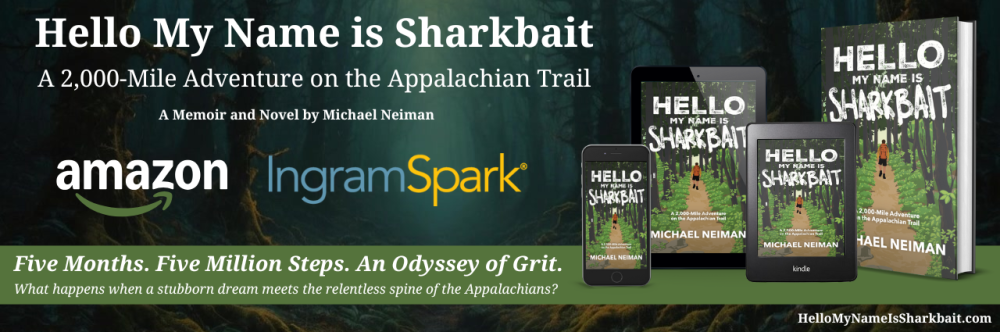
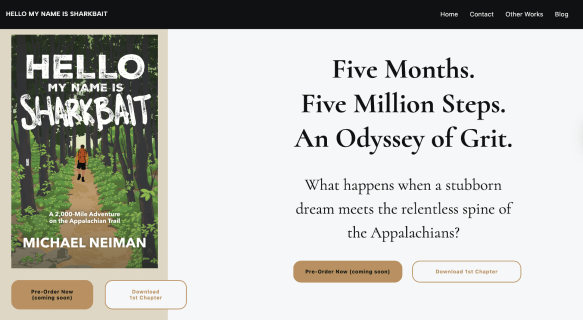
Website Launch and a Journey of Marketing & Promotions

BOOM. The official website to help promote Hello My Name is Sharkbait is live! For those who have already checked out the pre-order page, you know it directs people to HelloMyNameIsSharkbait.com to get a free copy of Platinum Blazing with proof of purchase. But it also provides more detail about the book, about me, AND a sneak peek into the first chapter. What?! Yes! Marketing and promoting a book is incredibly difficult, but the first step is having a place to send people to learn more. And on December 22nd, something exciting is coming to kick off my book launch that will let people do just that…

However, before we delve into that breaking news, let’s discuss the incredibly challenging task of self-promoting and marketing one’s work. This can branch in a thousand different directions, but I’m going to try to focus on what I know (little as it may be), what I’m planning, and what pitfalls I’m avoiding… for now.

Let’s be clear on one thing. The second SEO picked up on my book journey, I was FLOODED with advertisements for products and services eager to take my money with empty promises to drive up sales. YouTube, Facebook, Instagram, Google … literally everywhere I look online, I’m being berated more than a tourist in Thailand. And it’s exhaustingly overwhelming. Ironically, they are doing to me exactly what they are offering to do for me. Relentlessly show promotional videos, ads, and promos until would-be buyers just give in and purchase. Admit it, you’ve bought the Tumbler Knife Sharpener by now. So what is a self-promoter to do?

Soft Launch. Everything I’ve shared on this blog leading up to and shortly after my December 24th release date. The initial announcement tease, the title & cover reveal, the pre-order launch, this post, and more. A thank you to my loyal readers… I’m incredibly grateful for your interest and support. Whether you buy it or not. I hope you do (and seriously, 5-star review), but I appreciate you either way. The feature photos at the top of those posts were all made on Canva with their stock images or 3D elements from DIY Covers. As well as the site banners and Instagram/Facebook promos. I could pay the 21st-century version of Don Draper to do this for me, but free tools today make it very simple (albeit a learning curve). Canva even has an AI chatbot to help when you can’t figure out how to make a GIF (thank you oh merciful robot overloads). I also used Canva to make the Instagram/Facebook video reels I’ve shared with quotes and rolling AT views. I’ll admit these are a bit more amateur … and I have no idea how reels actually work, let alone how to get them noticed, but it’s been fun. My goals for this phase are simple: 1) Get it launched in a safe space, 2) Get early adopters and 5-star reviews (if it were allowed, I’d literally pay you), and 3) Get feedback and momentum. If you all hate it, I can put it on a shelf and pat myself on the back for a job well done. But if you like it, I need that motivation to push harder and do more with the next 2 phases.

Local Promotions. This is the fun part, and comes with some pretty exciting news thanks to a friend. I want to launch my book intimately and in-person as much as possible. Author readings, book signings, local magazines/newspapers, nearby bookstores, regional TV/radio stations, and as many niche outlets that I have a personal connection to as possible. This memoir is a personal journey, but it’s been successful so far because of the support and common interests of others adjacent to me. I have connected with 3 bookstores in CT and NY, including the one in our hometown. They will have my books on the shelf in January and help me schedule in-person events like readings and signings. I also have a list of targeted magazines/newspapers/online journals I will pitch a feature story to. I am hopeful that at least our local Ridgefield ones will give me a look, but also some broader hiker ones like AT Journals that previously featured Platfinum Blazing, The Trek (a very popular thru-hiker blog/media site), various ATC and AMC clubs … and more. I am specifically targeting outlets that will relate to me or my journey with broader appeal. I’m optimistic, but haven’t begun this journey yet, which is likely to lead to a lot of ghosting. And all of this will kick off on December 22nd with something special planned while I am visiting Minnesota for the holidays. Stay tuned for an update next week on how you can be a part of the official launch party!

Online Promotions. Ugh. Honestly, this is so exhausting that it’s hard to even put a short summary together. Bottom line is that EVERYONE wants to make money off author desperation with veiled promises, how-to guides (really? books to help sell books), and AI-generated ad sales. The vast majority of these seem to run through two places … Facebook ads and Amazon ads. I assume FB ads include Instagram, but haven’t pursued this far yet. Amazon ads are big though, as they push your content to the top of search results, prompt your work on other similar pages, feature it on home pages based on your search results, etc. I’ve taken a gamble on 1 product I read about called Publisher Rocket, to help me get started. They had a great Black Friday deal, a really good video tutorial series, and I’ve already seen early payoffs on metadata tricks in my pre-order launch. This software is pretty impressive, and helped identify the exact keywords and categories with the highest chance of making me a bestseller. In fact, my pre-order sales already had me as the #1 New Release for a while in 2 categories: Walking and Travel Adventure Fiction. That’s pretty cool. Right?! … right? Anyways, the software helps you set up your book with the best chance of success, and then also provides additional resources to do Amazon ads after launch. Until I know whether that works or not, I’m not planning to buy into other platforms eagerly telling me that for “$1 a day I can make 7 figures in sales!”. Not saying I won’t, but I’m playing the long game on this book’s success. It might not be on the NYT Bestseller List out of the gate, but someday they’ll talk about it in the same breath as A Walk in the Woods and Wild. Right?!… right?

And that’s it. Sure, I could also hire marketing agencies to do this for a small fortune, or quit my job and tour America with hundreds of author copies to sell outside every Barnes & Noble. Or maybe even hire thousands of people in India to buy it for a 5-star review and reimburse them after as people 100%, definitely do. But I am not trying to fake it, I’m trying to make it. And I have a day job. I believe in my story and someday I hope enough other people do too. If I can leverage this strategy to get it in front of them, I think I can be successful.

Thanks for reading this far (Kirsten), and for all being a part of my trail journey a second time. Oh, and if I haven’t begged enough for your 5-star support yet, you’ll hear me ask again at launch… this time with a chance for fabulous prizes (fully in line with Amazon’s very specific and very threatening no purchasing of reviews policy).

Hello Neiman!

(p.s. I may need to figure out a long-term brand strategy that goes beyond Hello Neiman, which integrates my two websites more than just cross-linking. Time will have to tell, and suggestions welcome.)

Kindle Pre-Order Available, and an Adventure in Publishing

Pre-Order open! Hello My Name is Sharkbait is official on Amazon and available for Kindle pre-orders now! Paperback, Hardcover, and eBook are all approved and set for launch on December 24th across all platforms and bookstore locations. Pre-order is for Kindle only (not my rules, blame Amazon), so if you want a physical copy, you’ll need to wait until Christmas. And, no Audiobook yet (more on that later). It is surreal to see this finally out in the ether after so much work, and also more than a bit scary that there is no going back. I hope you like it. And if you don’t, I hope you give me a 5-star review anyway. No, seriously, do that. I’m like your Uber driver, begging for validation and social acceptance to drive sales! And if you want to learn more about the publishing journey that got me here, read on below…

If you read last week’s post and thought the editing process was cumbersome, boy do I have news for you. There is a WHOLE world of complexity and confusion to publishing, and I am starting to think it is on purpose to stifle competition. The good news is that there is a shortcut at every turn. The bad news is, they all come with hefty trade-offs. Trade-offs I wasn’t willing to make. So, as usual, I made this harder than needed. But in the end, I am glad I did.

Let’s get one thing out of the way, there are 2 routes to publishing: Traditional and Self. Six months ago, I began the traditional publishing route. I was eager, optimistic, and naïve. I had something that EVERYONE would want. Right?! … right?  Maybe, still to be determined. But here’s what happened…

Querying.  In traditional publishing, this is the next step. You have a manuscript … maybe it’s raw, maybe it’s edited and polished. You write something called a query letter and spam blast it to every publishing agent under the sun that you think hope pray will notice. That agent then gets you a publisher, editor, illustrator … all the things you expected to be easy and done for you, because you watched Younger on Netflix. I liken this to the kid who was lead in their High School production of West Side Story, flying out to NYC with a stack of headshots, then standing at the top of the Empire State Building and flinging them into the air. Everyone was bound to pick up the flyers and start fighting in the street about who gets to represent this amateur star-in-the-making. Right?! … right?

I had an awesome query letter. It led with a great hook, inspired comparison to other noteworthy authors in my genre, offered something unique, and called out my success in previous writing with this blog and Platinum Blazing. I spent weeks researching agents (who all annoyingly have different submission rules btw), sending a handful of inquiries. No one cared to even respond. I researched more, talked to other authors, Googled and YouTubed … a lot … and realized most first-time writers never get published traditionally. Agents simply don’t care about you because they think you have little to offer. To prove them wrong, I’d need to spend every hour of free time (I had none) door-knocking, networking, talking myself up at local author events, selling 10,000 books independently to get noticed … or go it alone. I’m sure I could have kept at it and proved to be the exception, but ain’t nobody got time for that. I had a full-time job, two toddlers, a new house that refused to go even a month without needing something repaired, and on and on. So I decided to learn everything I could and self-publish. I think I could now publish a book on how to self-publish. No, seriously. I am an expert. And I did everything wrong along the way to prove it.

Formatting.  Ok, so based on last week’s post, all the editing is done. You have a final draft manuscript and now it’s time to put it into a publishable format. This was so cool to see, like watching a pile of ingredients rise as a cake in the oven. You can do this yourself, or seek out very affordable outsourcing. I found my formatter from a YouTube recommendation and was incredibly impressed with his attention to detail to match my own low high-functioning OCD. The formatter’s job is to take your manuscript and get it print/digital ready. Print-ready is easy, just takes a little Microsoft Word know-how. But the epub files for reading on Kindle and non-Kindle devices are a bit more involved. I picked from a dozen templates the formatter offered, then he loaded everything in and sent the files back to me a couple days later. I’m sure he had a software solution that simplified all this, but the product he sent back was beautiful. Now all that was left to do was meticulously review all 390 pages in the 4 formats and make sure nothing looked off. Did I like how the title page is centered? The way he formatted text messaging? Did a single word to end the chapter slip to the next page? We went back and forth a few times on image sizes, headings, formatting, and fonts … so many fonts … until it looked perfect.

Warning, major frustrations ahead.

Proofreading.  Some people say you should proofread before the formatting, others say after. I wish I had listened to more people, as it would have avoided so much rework and embarrassment. I made a gross miscalculation that my Copy and Line Editor caught all the spelling and grammar errors. In truth, he may have, but his edits sometimes led to minor rewrites on my part that likely introduced new errors. And I made another error trusting Amazon’s proofreading software, which said there were no errors. I was so proud of the finished file that I shared it with Dana (who politely refused to read it previously until it was done). She didn’t get past the dedication before finding an error.  Then she found another in the first sentence of the Preface.  I yanked the Kindle from her grasp and spent an entire weekend re-reading my book, cover-to-cover, and meticulously proofreading again. I had a list 5 pages long by the end and buried my head in my hands. When I say I almost cried that this was the product about to go out with my name on it, I mean it. To be triple-safe, I bought proofreading software and ran every chapter through it to catch and fix anything I missed during the weekend’s read.  I’m confident now of two things: 1) this book is ready for primetime, and 2) there is undoubtedly an error I missed.  Perfection is really hard to achieve, so I welcome any errors my early readers find that I can update into a Second Edition.  I gave the updated manuscript to my formatter and loaded the updated file from him to Dana’s Kindle for her to read again. No word yet if she made it to chapter one error-free.

ISBNs, Barcodes, Pricing.  Ok, now we are ready to load the manuscript into Amazon and Ingram Sparks (distributor for everyone else), but are immediately hit with another snag.  No way to proceed unless you provide an ISBN and barcode, or let Amazon or IS make one for you. The problem with letting them do that, is you then grant them exclusive rights to all distribution.  If I let Amazon create them, I can’t sell on IS, which is how bookstores can place orders. If I let IS create them, I can’t use Amazon’s Kindle Direct Publishing (KDP) interface for marketing, promotions, and daily revenue tracking (e.g., create an ad and track whether it generates sales or wastes my money). After more research (seriously, the next book is coming), I realized most legit authors buy their own ISBNs and barcodes so you can use both services.  ISBNs in the US are sold only by Bowker and can be purchased individually ($125) or in bulk (10 for $295).  Because I needed 3 ISBNs, one for each format, I now have a pack of 10. If anyone wants to publish under my imprint, I’m happy to supply ISBNs to you. Also, I have my own imprint now. You can be jealous.  And by the way, barcodes are also sold by Bowker for $25 each. You can either put the price on the barcode or omit it. My research suggested including it, as bookstores prefer it there. I bought for the paperback and hardcover, pricing them as I expected to sell. You don’t need a barcode for an ebook, and technically don’t need an ISBN either. But again, it’s a recommended best practice to maintain cross-platform ownership rights of the work. 

And here’s where I hit YET ANOTHER snag. Are you seeing the trend? What frustrated me the most is that Amazon and IS restrict you from moving forward in their process w/o certain things being done. I couldn’t buy a barcode until I decided on price, and I couldn’t see royalties of price until I uploaded the manuscript and cover … but I couldn’t upload the cover until I had a barcode with a price. I was stuck in an extremely annoying design loop. I was desperately trying to do things in parallel to avoid a 6-month publishing process, but the dependencies ended up just causing rework. When I finally got everything loaded and to the pricing pages, I learned that the price I prematurely chose for my barcode would sell at a loss, and I was going to owe money for every book distributed by IS. My book’s price point was intentionally set to attract as many potential buyers as possible at a psychologically low threshold. I’m sorry I had to up the prices, but even ChatGPT says I am still low for my page length and genre. I hope the extra couple bucks doesn’t dissuade you.

Covers.  Barcode issue aside, this was a fun ride. Amazon, IS, and many free online services will create book covers for free.  They have templates and use AI to pump out an indefinite number of covers that all look professional and expensive. I could have done this, maybe I should have done this, but I wanted to do the entire project w/o AI and had a vision that didn’t seem to align with all the cheap or generic fantasy/sci-fi/romance focused styles out there. It’s clear those 3 genres are the MOST popular in writing, and I’m confident I can now pick out an AI cover instantly from a bookshelf. I also needed some illustrations for my manuscript, so I once again sought out a professional. Fortunately, I found one that I knew I would love. My buddy Adam (also a character in the book) owns a Talent Staffing Agency and works with an illustrator for many of his promotional materials. I’d seen her work on his LinkedIn posts, they were good. I also wanted something that paid homage to Bill Bryson’s book. And I wanted all of it to be in the style of the National Park Posters that I love and have hanging in our home. I started talking with Emily over the summer and she got to work on the interior illustrations and exterior book jacket with my vision in mind. Of course, I had a LOT of opinions on this, everything from font choice to color palette for trees. Research will tell you, there is nothing more important to encourage potential buyers than the cover. Even the title doesn’t matter if the cover doesn’t catch their eye. I appreciated working with a professional who took my OCD in stride and got to the finished product you see above, which I think fully captures my brand and story. It’s not just eye-candy with no relation to the actual story, and it is not just generic images. It is me, it is my journey. And when you read it, you’ll see why.

And that’s it.  Formatted manuscript, Book Cover, ISBN, Barcode, Pricing, Amazon KDP and Ingram Spark setup, Book Description, Keywords and Categories (will touch on those last 2 next week, as there is a whole underground of knowledge on manipulating Amazon and best-seller status with the right metadata).  Looking back, I think I made it sound easier in this blog than it was. But honestly, each phase took countless hours of research to even know the options, let alone pick the right path. Lots of YouTube videos, ChatGPT prompts (“Act like a first-time author navigating self-publishing…”), author self-help Facebook groups, chats with support desk agents … and on, and on, and on. So yeah, you can do this on your own. It’s a world of pain, and it’s easy to get everything wrong if you want to do it yourself. But if a moron like me can do it, so can you.  Or you can just do this and make $1,000,000 a year selling AI-generated Word Search books.

And believe me when I say this isn’t the end. I fully intend to throw my headshot flyers off the Empire State Building again … only this time hopefully with some success behind my name.

Oh, and I teased I would come back to Audiobook, but today’s post is already too long. And let’s be honest, no one read this far anyway. Long story short, not sure if I can offer it at launch. Creating an audiobook requires one of 3 things: a) professional actors, b) self-narration, or c) approved AI voice-to-text.  The former can be expensive but I’m exploring options. The latter is only available in beta by invitation from Amazon KDP, which I don’t have, or otherwise restricted by Audible. I’d forgo my no-AI principle, since it is AI-assist and not AI-generative … but no invitation has shown up yet. So that just left me closing myself off in a closet and doing it myself to avoid the sound of screaming toddlers in the background. I hate hearing my voice on any sort of video, so I doubt I’ll be ok with a 10-hour narration of my novel.  Then again, memoirs are typically narrated by their authors, so I may just have to suck it up if I ever want a chance at Michael Fineman reading it. He’s also a character, sort of, so he should just buy the print version anyway.

Hello Neiman!

Hello My Name is Sharkbait: A 2,000-Mile Adventure on the Appalachian Trail

Hello My Name is Sharkbait! I am thrilled to share my book title and cover today, and a few more details on my writing journey leading up to launch. When I first started this project, I thought the title would be the hardest part. I mean, how could I sum up 20 years of planning and 150 days of walking appropriately? To inspire potential readers, I’d have to be creative, catchy, unique, and memorable … all with a few short words. But also, none of that matters if the book cover doesn’t translate it and convince you to stop and pick it up. Only time will tell, but I know this for sure … success or failure, it is 100% on brand. And when you read it, you’ll see why.

I’ll talk more about the cover in a future post, but first I want to explain my writing journey of the past many years. There are no less than 723 billion experts ready to tell you exactly how to write, edit, and publish a book. And wouldn’t you know it, they have 723 billion different opinions of exactly what to do. I won’t pretend to be an expert, or sum up the unlimited paths that could get you here, but I’ll share mine. This part gets long, so if you don’t care to hear me rant and rave about the intricate process, you can peace out here and come back next week to learn more about publishing and promotion. Teaser … how cool is that animated GIF at the top? Right?! … right?

Or unsubscribe, I won’t be offended. I’l know though, I always know.

Anyone still here? Ok great, grab a cup of coffee, and let’s dive in to the fun gift of feedback. A gift you pay a lot for.

Writing. I knew I wanted to create a novel that followed my real journey, but not just repeat my journal. I spent years reviewing my blog entries … both to relive the fun, but also start taking note of my favorite stories, memorable characters, and dramatic moments that could translate best. I finally formed a rough outline of ideas, and then when I sat down to write … realized I had no idea how to operationalize it. I wasn’t a trained novelist. I simply didn’t know the mechanics. How would I translate inner monologue ramblings into action sequences and character dialogue? I had no idea (and ChatGPT didn’t really exist mainstream yet). So I did the next best thing, I hired help. I paid a writing coach to read every blog entry and watch every YouTube video from 2018, then spent the next 12 months carving out the manuscript draft with her expert guidance. I wrote one chapter a week and edited another after her feedback. It was sloppy at first, but much like my blog writing, eventually found its rhythm. The process was painful (so many late nights!), but it started to transform me from an amateur writer into an author. Total cost, $1400.

Editing. I loved writing, but holy hell did I hate editing. Is there anything worse than being told your baby is ugly? Or that your great idea falls flat? Or my personal favorite, “No one cares about your gear and meal plan.” This process took another FULL year, and honestly, could have gone longer if I wasn’t so OCD hell-bent on getting this done by the holidays. There are very structured rounds of editing in the book publishing world, and I was committed to doing them all to create a finished product any agent that passed me up would regret as much as snubbing Julia Roberts on Rodeo Drive. Big mistake. Huge.

Step 1 – Beta Readers. The first step is to pay someone to read your very raw manuscript and tell you everything wrong with it. You typically get a 1-2 page opinion back that requires more work. I decided to shortcut this a bit and had an author friend do a full read, and a few strangers read the opening chapters. I got great feedback, hard as it was, and knew where I had work to do. The more you do this, ideally, the less painful future steps are. Total cost, $200

Step 2 – Revisions. Feedback acquired, I spent 2 months restructuring some early storylines that didn’t pay off (“false peaks” as they’re called in the industry, an apt name for a book about the AT). I cut planning chapters and integrated them in as later flashbacks or anecdotes. I removed entire characters that didn’t pay off, and expanded storylines for more threaded continuity. But, I was still writing a narrative non-fiction, so didn’t want to just make things up. It’s written like a novel, but it’s also a memoir. So this took a bit of creativity. By the end, I’d say 95% of the story is still true, with some caveats. For example, one of the main characters is a combination of 3 actual people – my college roommate, my long-time hiking buddy, and another friend who joined me the first week. Those moments are real, those 3 people will know them … even if called by a different name. Also, let’s be honest, most of the dialogue is my interpretation of 6 year old memories and what the scene needed in addition. Total cost, $0.

Step 5 – Developmental Edit. Now that I had a less-raw 2nd draft, it was time to get a real editor. This is similar to beta reading, but on steroids. Now you pay someone a lot more money for a weekly word count to read your chapters, give you in-line comments of where to rework sections, and a final synopsis at the end of it’s core problems. I was not a huge fan, but it was a necessary evil. We spent 4 months together doing groups of chapters at a time, reviewing and responding to feedback … cutting, re-writing, adding. A lot of adding. By the end, it was definitely more polished (“make sure you add dialogue tags so people don’t lose track who’s talking.” “is this the same day or later? be specific in timing.”) … but also 20,000 words longer. I was writing a novel, not War and Peace. There was some minor inline copy editing, but mostly led to a better but longer rambling of the story. Total cost, $2300.

Step 6 – Copy and Line Edit. Ok, this is where it got fun. If you find a good copy editor, you can run through the forest with a machete, slashing and carving a clear path to the other side. It was so refreshing to cut with precision and keep the story arcs in tact. This focused on spelling, grammar, sentence structure, style-guide rules, and word-by-word selection. I found a great editor that knew exactly what I wanted and how to deliver. We switched to compound words, removed “that” a lot, redacted things that didn’t make the sentence better, etc. The 20,000 words added previously were all smoothed out to good length and well-paced read. There are a lot of AI tools to do this step, but a real editor can drive consistency and unique styling. For me, this was important for many reasons, one of them being numbers. Numbers are critical in a story about measuring miles, counting calories, blogging days, etc. Every time a number was used, we had to make sure it was correctly numeric or written out. And the copy edits had to be perfect. There was no going back to fix a misplaced comma for someone’s paperback on the shelf. This whole process took about 6 weeks, because it was not about content as much as choice. Total cost, $600.

Final cost, $4,500. Plus a lot of blood, sweat, tears, sleepless nights, hurt ego, delayed priorities of normal life, and probably some future carpal tunnel. So trust me when I say thank you for even considering to buy my baby.

After 2 years, I had reviewed, read, and rewritten the chapters more times than I could count. It sort of makes you respect why some actors rarely watch their own movies after filming wraps. If I wanted, I could have done this cycle over and over again for another 5 years. Maybe after a dozen more rounds it would be better than today? Tough to say, but it’s definitely ready. And honestly, if I didn’t love the story so much, I’d be damn sick of the book at this point. It could be the torture-loving masochist in me, or just the self-absorbed persona of us narcissist types that decide to write memoirs … but I still love it.

Hello Neiman!