Teva Excursion to Paraty – Day 1

Not really sure how to sum up our 53 hour excursion to Paraty, Brazil in a short post, but I will do my best. When I worked at Herzl Camp, I coined the term “Teva (Nature) Excursion” for the overnight trip in the woods we would take the campers. I feel like this weekend has given that term a whole new meaning, as it was an extreme trip where my sub-group of 4 (quickly named “Team Bad-a**) refused to back down from any challenge. This was the Paraty Teva Excursion (and the first of my 2013 resolution to do 5 new adventures).

Friday, Jan 11
8:00pm – Board the bus for a 250 km ride to Paraty

Saturday, Jan 12
3:00am – After 7 hours of navigating mountainous roads with 45 degree inclines, no concept of slowing down, and speed bumps every 100 meters in a sh*tty bus, we finally arrive in the colonial city of Paraty. Cobblestone roads, beaches, tourism, mountains, rainforest looking foliage … even the awful trip couldn’t take away from the hope of adventure to come.

5:30am – Wow. Two and a half hours of negotiating with our bus driver finally done. The guy was supposed to stay in Paraty with us, but never mentioned we were to book him a place to stay. Nor that it had to be a private place to his “standards”. There were no rooms left at the hostel so i offered up my bed, he refused. We offered another hostel with a private room, he refused. Finally, we gave him US$200 and sent him to a hotel, telling him we didn’t want to see him again until Sunday at 5pm for the trip back. Between 25 of us, it was about $8 each, worth the price of an extra hour of sleep at this point.

9:00am – After a very relaxing 3.5 hour nap on a hammock, we awoke to start the day. Team Bad-a** rented mountain bikes and took to the mountains. It was a total of 20 km roundtrip, straight up, then back down, then up the other side and down again. The bikes were … ok … they held up well on the way up, but had ABSOLUTELY no breaks coming down. I used my feet, the bushes, and other death-defying maneuvers to keep me from barreling head first into passing cars on the narrow windy road. But the views were worth it, simply an incredible countryside.

2:00pm – We get to the first waterfall, Cachoeira de Penha and learned how to surf/slide down the falls into the pool below. I have never seen the likes of this before, wow. The locals were slightly better than us, but it was still awesome to try.

4:00pm – We continue the bike trek down the mountain and back up the other side. Navigating this “rainforest” terrain felt like I was on the set of LOST. Overgrown tropical vegetation, deserted buildings in the distance … even a radio tower on the top of a mountain. JJ Abrams must have come here for his initial inspiration.
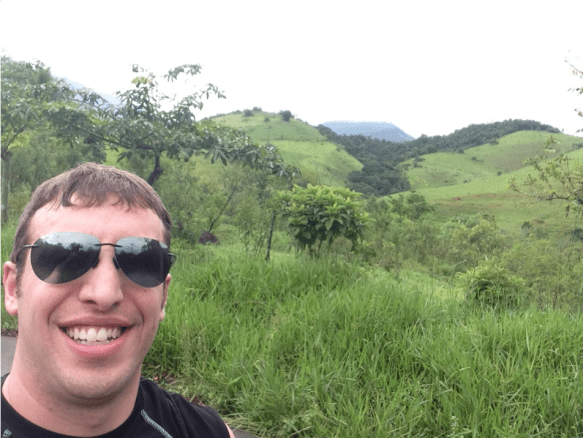
5:00pm – We get to the second waterfall, Cachoeira de Pedra Blanca and went nuts with diving off the cliffs into the pools and navigating the different sections of waterfall. This was about 3 times the size of Gooseberry Falls, and an incredible sight worth the extra trip up the mountain again.

5:30pm – Side story. Paige broke the key into the bike lock, stranding us on the mountain top after everyone went home for the night. We were the last people there, with no way to get down besides walking, but we got lucky in that one of the remaining park guides happened to have a hacksaw on hand. Only in Brazil! After a quick scare, we made our way back down the mountain again (just as scared).

7:00pm – Drop off the bikes, having somehow miraculously survived the downhill run again (this time, holding the brakes firm to the handlebars praying somehow it would magically stop the bike if needed. It didn’t.)

9:00pm – Time for the highlight of the weekend: A local version of the Brazilian Churrascaria at our hostel, Che Lagarto. For US$13, we had more variety and quantity of meat then I have ever seen below. The picture here is about 1/3 what they made, not to mention the full table of breads, vegetables, salads … and a free Caipirinha (sugar cane rum, lime, sugar). We had a bartender doing bar tricks (at one point he juggled bottles lit on fire), and a live band playing traditional Brazilian music. A fantastic party!

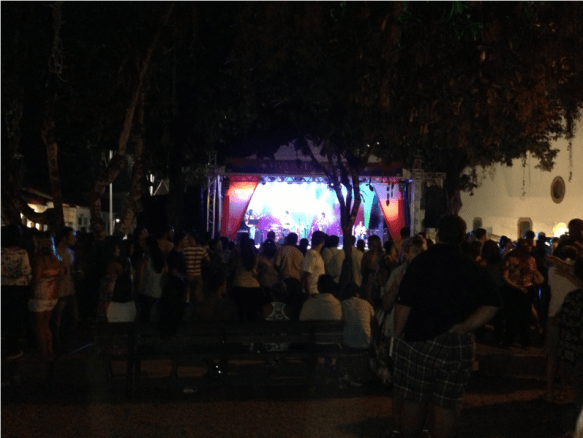
12:00pm – We head out to join the locals at the town “Centro”, or central square. Live music, bars surrounding the square, and thousands of people just hanging out. It was like a South American version of New Orleans, and just as exciting. Even managed to find a bar to see the Packers get slaughtered.
Stay tuned for Day 2…
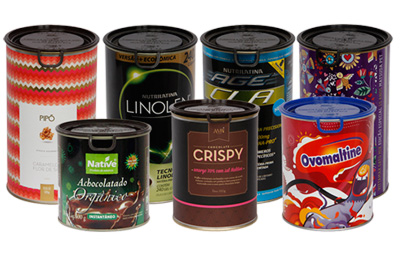
Company Tour: Brasilata

Our second company tour took place on Friday, where we visited the Brazilian manufacturing company, Brasilata. Brazilata is a family owned steel can producing company, with over 100 employees, and $250 million a year in sales. Most interesting, though, is their recent “Simplification Project” that for the past 25 years has earned them over 100 new canning industry patents, and put them on the map as one of Brazil’s “Best Places to Work”.

Brasilata adopted the Japanese process efficiency strategies of Kanban and Kaizan to drive innovation in their workplace, where employees (called “inventors”) at every level are encouraged to submit ideas for streamlining the workplace. From this program, they recorded nearly 150,000 ideas in 2012, with an adoption and acceptance rate of 92%. We spent about an hour talking with a Director in charge of the facility and learned why this process was so successful. A couple reasons we learned are below:

  • The goal is not to improve profits, but to improve the internal environment you work in
  • Employees do not receive monetary rewards, but rather symbolic recognition and shared profits
  • The 1000 employees, together, own 15% of the company, and therefore collectively gain from improvements to the bottom line
  • 99% of the ideas cost less than $500 to implement and therefore can be done immediately by teams
  • Each month, the best ideas are submitted and recognized in each department\
  • At the end of the year, the best idea receives the “Super Cup” for greatest recognition
  • Ownership of ideas does not exist, everyone owns them together and builds on them together

On the surface, this has a bit of a socialist mentality where the work/gain of all is shared by all. However, the program works and has made Brasilata the market leader in South America that it is today. It is hard to think that a company that specializes in paint cans, aerosol spray cans, and other chemical containers can be so changeable, but they are among the highest innovators in the world and continuously improve their products, processes, and strategies.

When you look at what you do day to day, how many of these are ideas you can share? A spreadsheet to track progress of a project, a new use of social media to share knowledge, a solution to a problem emailed to you? These are all the types of ideas that Brasilata encourages and records, and the results have been extremely rewarding for them.

It was a good visit, and a nice discussion with one of the company’s top executives. A nice change of pace from the first visit to Natura, where we were given a tour guide and treated more like generic visitors. At Brasilata, we had a chance to evaluate, analyze, and discuss the unique culture of this company with its leaders, and therefore received a better understanding of “Doing Business in Brazil”.

The $10 Pineapple

Funny story. We went to the Mercado Municipal (market) today for lunch (Kelner convinced me to make the 1 hour trip for a deli style 100% beef bologna sandwich, and even though they messed up and gave us Turkey … it was still a-wait-for-it-mazing (#1 below). I’ll have to go back next week for that sandwich again, because damnit if i don’t love me some good processed beef.

Ok, so back to the story. It reminded me of the first trip to the market last Monday, during the city tour. One of the things this market is known for is it’s exotic fruit selection. Fruit stands surround the market hawking dozens of tropical fruit you have never seen before. Some of my favorites were the “has a cashew nut sticking out of the top” fruit (#2 below), the “looks and tastes like an artichoke fruit” (#3 below), and the “giant red kohlrabi looking thing with white kiwi center” fruit. These are the official technical names of course. After 30 minutes of tasting these incredibly sweet and juicy treats, we were ready to buy … and then we learned the prices. Artichoke fruit? US$10, White kiwi thing? US$25. Regular old Pineapple? US$10. You could say this is because we were American, but i witnessed locals buying at these prices too.

I picked out the artichoke fruit (which was incredible), then wanted a pineapple. Those cost a buck at the minneapolis farmer’s market, so I figured the price is negotiable. No deal. The guy would not allow much haggling, and I ultimately passed on it. I can only imagine what these guys bring in a year with fruit costs so high. But then, the best part! As we are leaving we drove around the corner where some homeless people surrounded the streets. And right there on the corner, were 10 boxes of pineapples with at least 10 fruits in each. $1000 worth of pineapples there for the taking and dozens of hungry poor Brazilians just walking past them! What is going on???

Later, I went to a grocery store, and found the same darn pineapple for about $3 US. I have now figured out how to “Do Business in Brazil”. Take a sh*tload of pineapples from the grocery store and sell it for $9 next to the market. Instant billionaire.

After a commercial break, we’ll be right back … to commercials.

I am not a very big political activist. Anyone who knows me knows how I typically vote. And anyone who knows my demographic data: religion, income, residence location, social class, etc. can probably figure it out too. In the US, this is something we joke about, but every election always comes down to a few key swing states that can go to either party. States like Ohio and Florida decide the election every year, because states like Minnesota and Alabama never change.

Now enter Brazil, and your whole political stigma is thrown out the window. We discussed in our Political, Economic and Social Structure course that, on average, 40% of Brazilians change their party preference each election. That is an incredible number, but it may have something to do with the party system as well. There are apparently over 30 political parties in Brazil, meaning you rarely have an elected official with the majority of the vote anyway. And how do you learn about these candidates? Interestingly, Brazil has a mandatory 2-hour television program on every channel for every day of the month leading up to an election. This 2-hour block is dedicated solely to political campaigning, which is often created right up to the last minute as candidates poll uncertain voters. With so many candidates to choose from, and the forced marketing programming, it’s easy to understand why 40% are swayed each time.

What does this mean? Well, that’s tough to say, because so much of Sao Paulo’s culture is young and new. They are still figuring out what works, what doesn’t, and what systems will bring the best results. On the one hand, it is nice to have a forcefully informed decision between multiple candidates, but must be very hard to get any traction as a political candidate. Franken and Klobuchar would have their work cut out for them.

Week 1 Takeaway: Sao Paulo Business and Culture

My homework assignment this week was to provide a 1 page reflection paper on some of the teachings and learnings from this week’s classes. Unfortunately, with such an intense amount of information, concepts, and culture exposure during these past few days … writing 1 page paper sounded impossible. Especially since I really like to hear/see myself talk…

For the paper, I chose to focus on one key quote, concept, or theme from each professor/guide, and how it helped shape my unique cultural understanding of the people and business in Sao Paulo. After evaluating the notes and pictures I took this week, I am submitting what you see below. Take much of my “facts” with a grain of salt, as they are completely unverified.

Sao Paulo City Tour: “This train station is an exact replica of the King’s Cross Station in London.” -Tour Guide
Our Sao Paulo tour guide said this proudly as we walked around the mega train station pictured below. At first I thought it exciting as well, but then the day went on: the Banespa skyscraper built as an exact replica of the Empire State Building, Cable cars surrounding a “Largo de San Francisco”, Ibirapuero Park resembling Central Park in NYC, the upcoming Templo de Solomao being built as an exact replica to Jerusalem’s Temple of Solomon. These buildings provide visiting tourists and businesses with familiarity and sites to visit, but it was a slight disappointment to me as well. In my pre-trip preparations, I read about how Sao Paulo is known for its incredible architecture and design by famous designers like Azevedo, Niemeyer, Marx, and Mendes da Rocha. There definitely are other incredible works, such as the Sao Paulo Museum of Art that is suspended above ground by 2 lateral beams, but we we were not exposed to these. This theme of replication may tie back to Brazil’s natural culture to avoid planning. More on this next…


Brazilian Business: “You don’t have to do it today, if you can pay someone to do it tomorrow.” -Prof. Gilberto Sarfati

Brazil is a culture of avoidance. The culture has a lack of planning, accountability, timeliness, and inhibits a general stereotype of “”laziness””. Sound bad? To us, sure … but apparently not to native Brazilians. This is the style they enjoy, and business tends to follow the trend. If a Brazilian worker says “”I will get this to you tomorrow””, what they are really saying is “”I will get this to you anytime after today.”” Coming from a consulting background, this concept feels exceptionally foreign to me. How can you deliver results by the timelines promised, meet contractual obligations, and provide high value consistently if you do not respect timelines? The architecture examples discussed above help explain my understanding of this concept. Why expend more effort and money to design a new train station, when there is a very reputable train station in England you can easily replicate? To readers unfamiliar with São Paulo, this may sound like negative stereotyping and discrimination. However, this is how it was shared to us by Prof. Sarfati, and apparently how most people from São Paulo would describe themselves as well. To Brazilians, it is not laziness, in fact it is considered noble to not work. But perhaps this is due to the lack of social discrimination in Brazil. More on that next…


Brazilian Culture: “I am an Egyptian Jew, my wife is Japanese, but we are both Brazilian and that’s it.” – Prof. Gilberto Sarfati

Brazil is a true Melting Pot. Initial ethnic figures were a mixture of native Indians, black slaves, and Portuguese colonizers. Now, as a historian I will need to look this up at home, but apparently the Portuguese plan was never to colonize and push other cultures out, like the Spanish and English. Portugal simply wanted to export the resources back to Europe and did not care about the inhabitants of Brazil. Instant social acceptance, right there. From the very beginning, these cultures merged together and it was not only acceptable, but expected, to instantly merge communities together. There is literally no term for “”Mixed Couple”” in Brazil, and their has never been a Civil Rights Movement. Simply put, there are no minorities in Brazil, because social integration is natural. São Paulo is only 150 years developed as well, with means everyone is basically still an immigrant. Being from the US, this is very difficult to believe, but here is an example: The most authentic Sao Paulan food is Pizza (Italian), and the most common is Rice and Beans (African). Having spent years studying social culture and humanities in the US, this concept is amazing to me. Imagine how different the world would be if European countries all shared this concept before spreading out to “”conquer”” the western world. All cultures in Brazil simply work well together, which is one of the reason’s the Natura company’s Ekos line is so successful. More on that next…


Natura Company Visit: “The sustainable business model for Ekos takes into account the socioeconomic development of rural producers” – Natura website

On Wednesday we visited the Brazilian company Natura. Natura is a consultant-based cosmetic company similar to Avon or Mary Kay. The produce products and catalogs, and then employ millions of consultants to sell them in stores, door-to-door, etc. One of the key differentiators of Natura, is their consistent focus on corporate responsibility to the environment, sustainability, and organic products. To understand this better, we discussed a new product line called Ekos, which partners with 50 underdeveloped communities in Brazil that help produce the goods. As a skeptical American, I naturally think “”ok, Natura sought out these communities so they can take advantage of cheap labor””. However, if you read their website, watch the videos, etc. you can see that this is not the case. The Ekos line truly helps benefit these communities, lifting them out of third world status and allowing Natura to give back to the community as much as they take. Much more than just paying for the labor, Natura is investing in communities with infrastructure, technology, etc. According to my very limited research, these amenities are more important to the community’s wealth than the paychecks they receive. However, this may be because their paycheck is literally worth less tomorrow than it is today. More on that next…


Banking in Brazil: “Brazil has the highest inflation rate of any country. The cumulative devaluation of Brazilian currency, over past 70 years, added up to 2,750,000,000,000,000%.” Prof. Rafael Schiozer

Many of our professors talk about the inflation rate in Brazil, and how it is the highest in the world. Stories were shared about getting your paycheck and immediately buying groceries, because food prices go up 20% the next day. I struggle with understanding the true impact of this inflation rate, but even more I wonder how Brazil can be an emerging market if investments will be worth so little over time. Why would I invest money in this market, if it will be worth 20% less tomorrow? I imagine this has been a significant barrier to entry for many foreign companies looking to do business in Brazil. However, this is also probably why the banking industry is so successful. Citibank and HSBC expanded to Brazil and have done very well here. And you can not walk 10 feet without seeing an advertisement for Banco Itau, Brazil’s largest domestic bank (even our classroom is sponsored by Itau, see pic). The Brazilian President made this one of his top priorities over the past 10 years, championing a campaign to move to “”0% inflation””, and it will be very interesting to track this and foreign expansion here over time.

This reflection was supposed to be just 1 page, but it is hard to stop once you get going. I’ve already shared, from previous posts, my reflection on a couple other professors and concepts. and will continue to reflect on these learnings and more while down here. Brazil is an incredibly unique country and Sao Paulo’s financial success is one that every business student should study. No doubt the other programs at the Carlson school are equally beneficial, but I am very glad I chose this one and am excited to see what next week’s classes and company visits bring.

Sao Paulo has the best…

Yesterday we went on a bus tour around the city of Sao Paulo. FGV University put this together for us, and along with a few faculty members, invited a professional tour guide to talk us through the various sites. Most of what we saw was identical to the 1-Day recommended tour from my TripAdvisor City Guide map (highly recommend this app, it downloads a city once and then has fully available maps, tours, recommendations, GPS, etc. while offline).

I got a little sick of hearing, Sao Paulo has “the best…” or “the most…” or “the biggest…”, but when you have a city of 22 million people, the statistics are bound to start adding up. Here are just a few things we learned on tour yesterday. Sao Paulo is/has the…

  • 4th largest city in the world
  • Largest fleet of personal helicopters (470) in the world
  • 5th most skyscrapers (over 5,700)
  • 10th richest city, with nearly $400 billion in GDP purchase power
  • 6th most billionaires (21)
  • 4th most active on Twitter
  • Most Porsches, Lamborghinis and Ferraris
  • Largest exporter of beef, chicken, coffee, tobacco, iron, steel, and more
  • 3rd largest airline manufacturer
  • Largest oil reserves (mostly offshore), producing 60 million barrels a day
  • First country to provide free Cancer and HIV/AIDS healthcare
  • Home to the 4th largest cathedral (Sao Paulo Cathedral, pictured above)
  • Home to the 2014 World Cup and the 2016 Summer Olympics

Would you like to know more?

The Dolphin Tuna: US Trade Power Over the Americas

This morning we had a lecture on Tariffs and Trades with Brazil and other emerging markets, known as the BRICS group (Brazil, Russia, India, China, South Africa). I continue to be impressed by the caliber of teacher our university, Fundacao Getulio Vargas (FGV), provides us. Each morning and afternoon we are met with FGV professors that are not only clear experts in their area, but speak with such passion and animation for their fields that we can not help but get caught up.

This morning was a prime example. There isn’t much in business that turns me off more than trade laws, tariffs, and treaties (well, maybe statistics) … and we had 3 hours of it this morning. On paper? Looked like hell. However, in person? Surprisingly interesting. I found myself constantly looking up additional info on the terms, treaties, stories, and charts the Prof quickly ran through to learn more and engage. And, by the way, I do mean “ran through”. I lost count of how many slides she skipped over, saying “you can read this one later in bed”.

One of my favorite discussions of the class was around the international animal rights that the US has attempted to impose at the WTO (and not just because I am marrying a veterinarian in 4 months). Sure, it’s a good cross-profession dinner table discussion for us, but this is generally an interesting look at US foreign trade relations that I think many will find interesting:

(no time to validate these facts, but just assume I’m right or look it up and tell me otherwise)

The Dolphin Tuna Fish Dilemma

The concept of dolphin-safe tuna labeling originated in the United States when the US wanted to increase tariffs to Mexico, if they did not impose changes to their tuna fishing practices. The problem, as you may remember, was that too many dolphins were being caught and killed in the nets of Mexican tuna fishing boats that import to the US. In 1989, the US. brought the “Marine Mammal Protection Act” to the WTO, which would have forced Mexico to change fishing practices. However, because this act was based on US only regulations, it violated the WTO Agreement on Technical Barriers to Trade (“Agreement”) and the WTO ruled in favor of Mexico (more info available here).

However, the US responded to this was with a marketing campaign to expose the issue to US citizens, driving down the sale of tuna fish to consumers. (I was only 8 but I remember my mother telling me to look on the label for “dolphin-free tuna”). The campaign worked, consumption fell, and Mexico eventually buckled. A new process was put in place where tuna fishing nets are collected a meter below the water surface (where supposedly dolphins can just jump over).

There is another example we discussed – Sea Turtles being caught in Brazilian lobster traps. But since Sea Turtles are an international endangered species, the US was correct in their imposition to the WTO, and practices changed quickly to allow an “escape hatch” for sea turtles to escape the traps. Check it out here for more info.

Hearing this story from the perspective of a Brazilian world trade expert certainly puts a different spin on the situation. It may be my natural pull to humanities teaching, but I truly enjoyed this historical and socio-political context to what would otherwise be dry statistics regurgitation. Our FGV professor did a great job of making us think analytically about the impacts to trade and treaty situations with Brazil, the BRICS group, and general foreign trade.

The $1 “Trillion” Coin

I woke up, my first morning in São Paulo, to learn of the US Government’s genius plan to save our economy with the minting of a $1 Trillion coin. I did not think much of it, besides how crazy an idea it was, and chuckled (past tense of Chaz?) as I made my way to class.

Our first class was called “Surviving Portuguese”, and was a 3 hour crash course in the native language. Luckily, Portuguese is written and read nearly identical to Spanish, so it was a good refresher from my last study abroad in Cuernavaca. Things were going around normally, until someone mentioned cultural differences in numbers. This became important as i thought about the CNN story on our new special coin.

I have studied 4 languages, and never before has this been brought to my attention before: 1 Trillion is NOT a universal quantity, and can be quite culturally confusing. In the US, 1 Trillion is a 1 followed by 12 zeros. However…

  • In England and Australia, a 1 followed by 18 zeros is “Trillion”
  • In Central and South America (Spanish/Portuguese), a 1 followed by 12 zeros is “Billion”

Fifteen years studying foreign languages, and this has never come up. I guess most professors never thought we’d ever use a number that high … but then again, we never had a coin worth that much either. If the general US consensus about this $1 Trillion coin sounds a bit crazy (spelled “Cryze” by our lovely professor today), I can only imagine what the English think of it.

Back, and Brazilian than Ever

Well well well, what have we here?! Hello Neiman is being resurrected (once again) at the start of 2013. But this time its not just for normal everyday blogging and FiveDollarLiving deals (sorry Edlavitch). While studying abroad in Sao Paulo, Brazil, I decided it would be fun to share a daily journal about some of the more unique and interesting things I am learning. It has been about one year since i posted, but hopefully the blog is still up, running, and posting to FB/Twitter appropriately.

Happy Reading and Hello Neiman!